
Find what you can actually reach
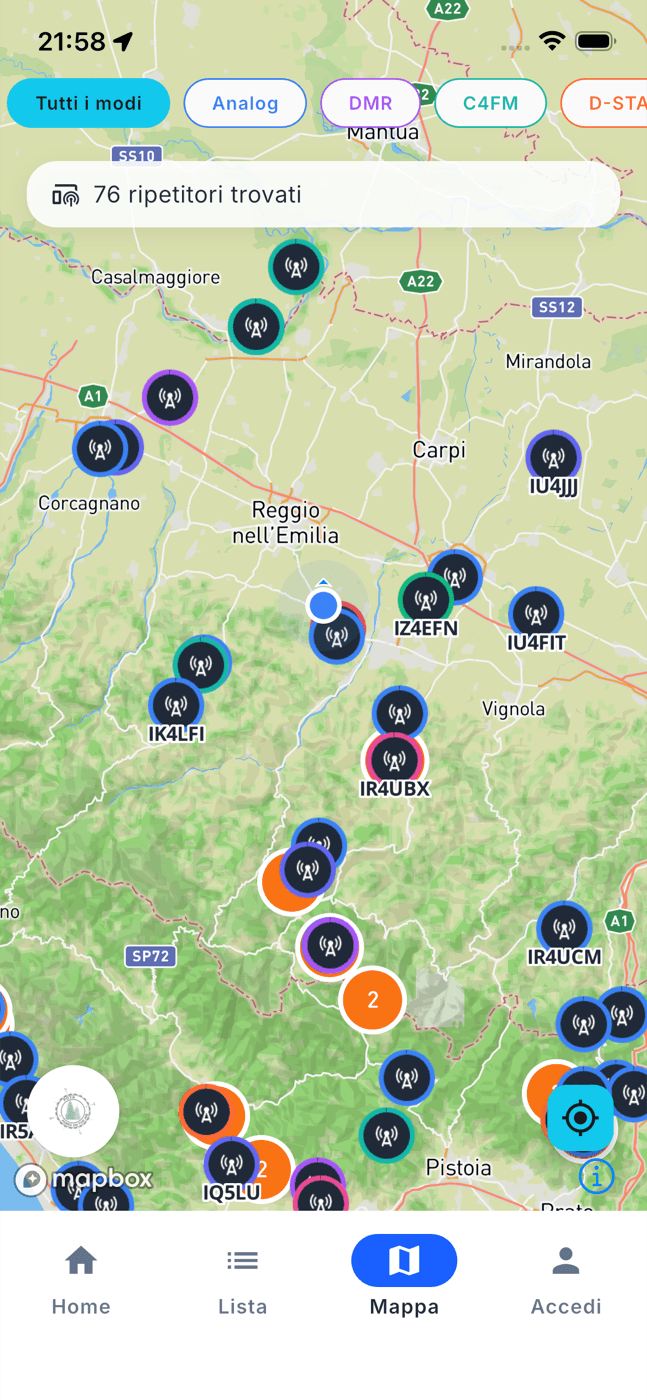
The map shows every repeater around you, colour-coded by mode, with your own position on it. Filter to the modes your radio supports and stop scrolling past machines you cannot work.
24,988 stations in 67 countries. Frequency, shift, tone, color code and mode — on a map, in your hand, with no signal needed.


Free. Browse without an account.
Everything a repeater list should tell you, and the things a printed one never could.
The map shows every repeater around you, colour-coded by mode, with your own position on it. Filter to the modes your radio supports and stop scrolling past machines you cannot work.
Type a frequency, a callsign, a town. 145.500, IR0UGM, Bologna — all of them find the station. Sort by distance when you are moving, by frequency when you are programming.
Output and input, shift, CTCSS on transmit and receive, DCS, DMR color code and talkgroup, C4FM DG-ID, node numbers. The full access data, ready to key into the radio.
The terrain profile between you and the repeater shows whether anything is in the way, so a dead carrier stops being a mystery.
See on the map where other operators have actually opened the machine, and how healthy its coverage looks right now.
Offline maps and the full database on the device. Mountain tops are exactly where you need this and exactly where there is no data.
Favourites keep the repeaters you actually use at the top, with their tones and offsets ready.
See who is on the air through a repeater right now, and get told when someone opens one you care about.
Because a frequency you cannot trust is worse than no frequency at all. In the app the data is versioned, corrected by operators, and available with no signal — which is exactly where you need it. The website tells you what exists and where; the app tells you how to work it.
The database currently holds stations across Europe, the Americas, Oceania and Asia. Every country with data has its own page, listed on the repeaters index.
Yes. The database and offline maps live on the device, which is the point — the places you need a repeater list are the places with no coverage.
No. Browsing, searching and reading the full technical data need no account. An account is only for favourites, feedback and spots, which are tied to you.
From national coordination bodies, network registries, and corrections sent in by operators using the app. Every station carries the date it was last updated.
The map, the search and every technical parameter are free with no account. HamQRG Pro adds the terrain profiles, coverage maps, offline map packs and alerts, and pays for keeping the data current.
Yes, and it is the fastest way for it to be corrected. Report it from the station page in the app; corrections are reviewed and published for everyone.
Every repeater on Earth.
The worldwide repeater directory, in your pocket.
Free. Browse without an account.


